
BACKGROUND
The Development Impact Measurement Department (CDI) at IFC analyzes economic sectors with a view to identifying opportunities and solutions for private sector development and works closely with IFC Operations. It provides technical support to operations related to structuring, appraising, and monitoring investment and advisory projects and is responsible for reporting on IFC’s impact. The department is in charge of implementing the ex-ante project assessment framework (Anticipated Impact Measurement and Monitoring- AIMM) for investment and advisory projects throughout the project cycle, helping ensure high-quality economic support for IFC operations teams on strategies and projects; and developing sector economic analyses with a focus on solutions for private sector development. CDI staff comprise mainly sector economists and results measurement specialists assigned to units organized along IFC industry groupings. These include units for Financial Institutions (CDIFI), Infrastructure (CDIIN), Manufacturing, Agribusiness, and Services (CDIMA), and Funds and Disruptive Technology team (CDIDF).
The Financial Institution Group team (CDIFI) is in charge of implementing CDI mandates and deliverables described above in relation to products, including investment and advisory to Financial Institutions, supporting microfinance, insurance, loans to small and medium enterprises and women-owned businesses, and affordable housing loans, among other areas. This includes fully developing and implementing the ex-ante project assessment framework for investment and advisory projects throughout the project cycle, monitoring and evaluating the impact of both investments and advisory projects, helping to ensure high-quality economic support for IFC FIG teams on strategies and projects, and developing sector economic analyses with a focus on solutions for private sector development. These activities will support operations done by Financial Institution Group (FIG) teams to deliver investments that support growing enterprises across emerging markets.
DUTIES AND RESPONSIBILITIES
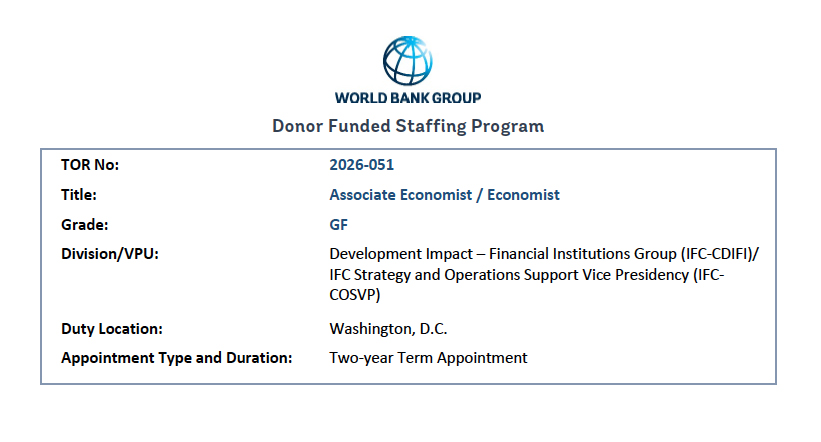
The Department is looking for an Economist based in Washington D.C. to provide, on an ongoing basis, expert advice and operational support to Investment and Advisory operational teams and management, assess the impact of financial sector development while ensuring consistent application of standard impact measurement and monitoring frameworks, generate relevant lessons learned and work with staff to incorporate such lessons into project design, provide technical support and program quality leadership to donor funded facilities, and contribute to evaluative work beyond the project lifecycle. The Economist will work in close collaboration with the Investment and Advisory Staff of the Financial Institutions Group (FIG), responsible for designing and structuring IFC’s financial sector operations, under the supervision of the CDI Manager for FIG. Key responsibilities include :
- Leading engagements with investment and advisory teams to ensure a well-articulated analysis of developmental impacts of FIG’s engagements in private sector development, applying IFC’ impact measurement and monitoring frameworks to assess the development potential of recommended interventions.
- Analyzing portfolio data on the characteristics of micro, small and medium enterprise (MSME) borrowers reached by IFC’s client financial institutions and the financial products these MSMEs access. Enhancing tools and systems to facilitate data collection and strengthen data quality and consistency. Ensuring the high-quality processing and harmonization of financial institution portfolio data on enterprise finance, to help leverage this data for project impact analysis and to inform project design by IFC investment and advisory officers.
- Working with industry teams and other departments to strengthen outcome measurement and monitoring across the portfolio of IFC’s financial institution investment and advisory projects and their contribution to World Bank Group (WBG) Scorecard indicators and strategic targets, including in the areas of jobs creation, access and usage of financial services, gender equality, climate and resilience, private capital enablement, among others. Analyzing data and contributing to the creation of sectoral, regional and platform level reports on development impact and outcome measurement to inform strategies and operational discussions.
Note : The selected candidate will not be assigned to programs involving their own government such as donor coordination and trust fund management.
SELECTION CRITERIA
- A master’s degree or PhD in economics, public policy, statistics, or related field with a minimum of 5 years of relevant experience.
- Ability to independently analyze data on financial markets and apply outcome measurement and monitoring methods to evaluate the economic and development impact of projects in areas such as enterprise finance, retail and digital financial services, sustainable energy finance, etc.
- Deep understanding of financial sector academic and business literature, and proven ability to analyze and apply economic theory and principles to areas related to financial markets and private sector development.
- Strong quantitative skills with a proven ability to gather, analyze, and interpret complex data to identify and translate insights to inform project design and implementation. Proficiency with statistical programs and experience working on large data management and visualization is strongly preferred.
- Highly organized and detail-oriented with a focus on quality deliverables, with the ability to understand and anticipate client needs. Outcome orientation and problem-solving attitude, with demonstrated capability to handle complex assignments and produce analytical work to a high professional standard, with minimum supervision.
- Proven ability to work in teams and capability to work in multi-cultural environments.
- Excellent written and verbal communication skills and ability to communicate effectively with different stakeholders.